
(January 15, 1948 – August 14, 2020)
and
Hertha Gretsch, World Traveler
(1889-1936)
by
David William Cohen
October 18, 2024
With hesitation, I am writing about my late partner, Gretchen Elsner-Sommer, who has been recognized, quite correctly, as a formidable authority on the history of the Gretsch family.
I met Gretchen in Evanston in 1989. I was moving to Northwestern University from Johns Hopkins in Baltimore. Gretchen was managing a household of three children, their ages stretching across the teenage years. She was the arts director of Women in the Director’s Chair, a feminist film organization based in Chicago. She was also running a unique one-person enterprise distributing the films of women directors based in Austria and Germany. And she had a most comfortable and much recommended bed-and-breakfast operation in her home at 1213 Maple Avenue. I was introduced to the B-and-B by my real estate agent who lived across the street, and who was Gretchen’s favorite realtor. And that’s how Gretchen and I met.
I have opened with an acknowledgement of “hesitation.” Gretchen is the one who should be assembling these jottings for a remembrance of the 140th anniversary of the founding of the Gretsch Company in 1883. But Gretchen passed away August 14, 2020—three years before that founding celebration and just one month after receiving a diagnosis that breast cancer had returned a fourth time, now metastasized to her liver with no hope for survival. Gretchen bravely created a safe space at home for her passing, and she died late in the evening with members of her family around her.
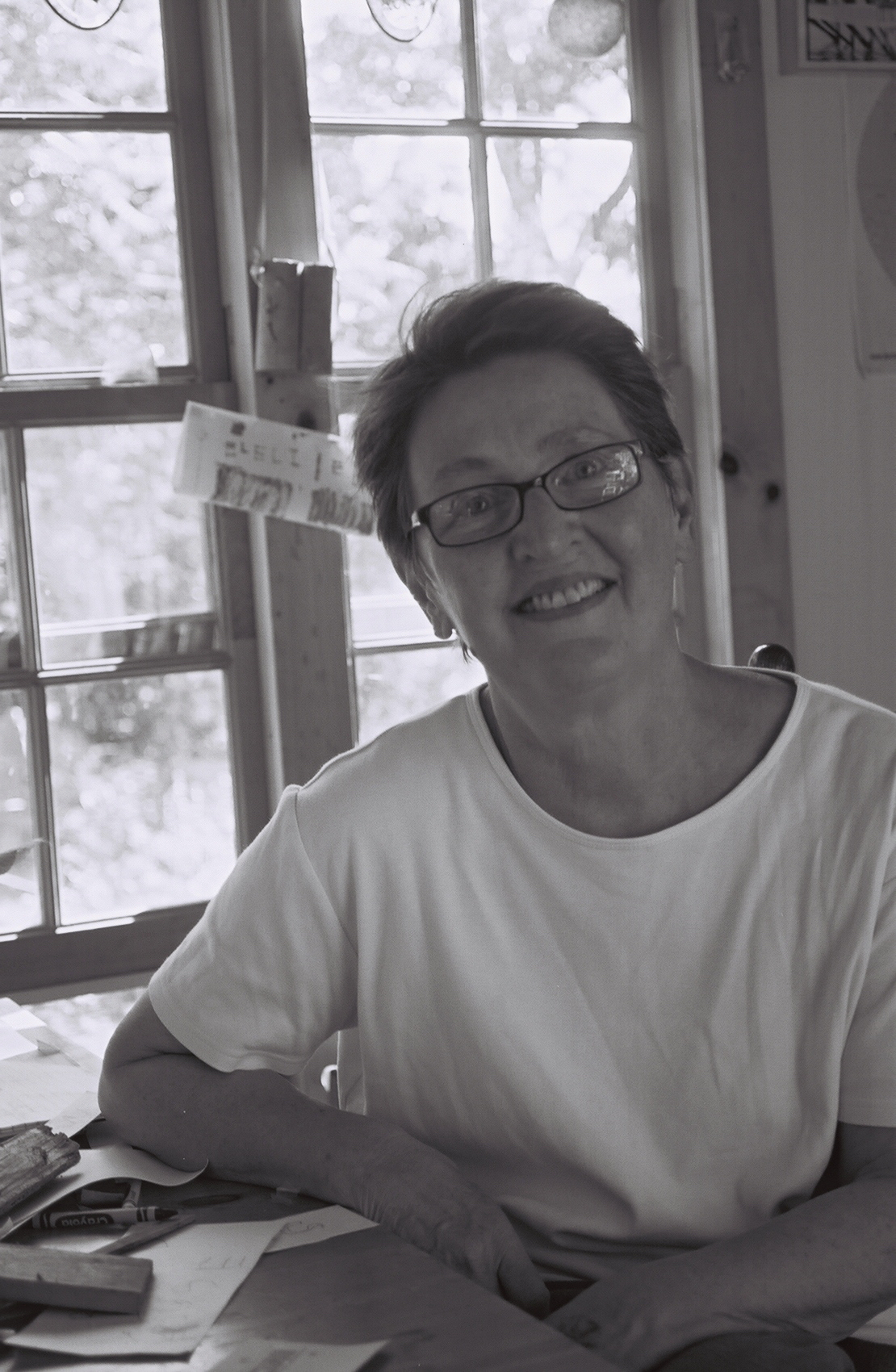
Gretchen
In the first weeks of our meeting in that summer of 1989, I learned a good deal from Gretchen about Gretsch as a family, and I learned about Gretsch, the company. Curiously, with money that I had earned as a teenager, I had for maybe a decade or so owned shares in the Baldwin Company. I hardly understood the Baldwin transition from a piano manufacturer to a conglomerate that took control of Gretsch. I sold those Baldwin shares at some point and only learned from Gretchen that I had been for a few years the owner, through my several Baldwin shares, of a piece of the Gretsch music instrument company dating back into the late 19th century. I learned how Gretsch had been extracted from Baldwin in 1984 and restored as an independent and family-owned business, with her brother Fred assuming the position held for more than a hundred years by a succession of men handing off leadership from generation to generation. And, as I learned more about Gretsch history, I came to understand that Chet Atkins—the Gretsch artist with whom I was most familiar—had left Gretsch, ultimately to join up with rival Gibson. . .not because he gave up on the Gretsch legacy but rather because he didn’t like what Baldwin was doing to “the great sound of Gretsch.” Falling in love with Gretchen, still in love with Chet, I found myself questioning my ownership of Baldwin shares. I can do a bit of math: Baldwin went bankrupt in 1983, on the 100th anniversary of Gretsch, almost taking Gretsch down the Baldwin sinkhole. I escaped the collapse by a year or two but after hearing Gretchen’s account, and after meeting her brother Fred, I wished I had never listened to whomever was barking about Baldwin being a hot stock to buy.
Of course, more importantly, I would instantly learn this important “footnote”: a woman, Rosa Schnappauff Gretsch, had held the business together—actually expanding its New York footprint dramatically—in the aftermath of her husband Fritz’s (Friedrich Gretsch’s) death in April 1895 from cholera while waiting to land in Hamburg harbor on a business trip from New York.

Rosa Schnappauff Gretsch (far right) and 6 of her 7 children,
3 years after the death of her husband. Hertha, Friedrich and Rosa’s
youngest daughter is in the middle.
I was coming to understand that Gretchen had been and would certainly continue to be recovering the history of her ancestry on both her father’s and her mother’s sides. And, within her father’s lineage—that part descending from the Hunsruck region of German Rhineland–Gretchen was focusing attention on the lives of women in that lineage. I was the academic historian, but Gretchen was the real historian within our growing partnership, thinking deeply about her past, and the past of her parents and ancestors and of, especially, the women in her ancestry. Working with great industry, Gretchen opened contacts with archivists and historians all around the world.
And she was very sensitive to the place of men in her life. . .and so challenging on this subject. In September 1989, on her first visit to my new office at Northwestern, she examined a postcard I had placed on a fireplace mantel. Gretchen asked, “Who is that woman in the image?” “What woman?” I blurted back. I hadn’t noticed the woman at the edge of the image; I had only focused on the figure in the center. And here, so much of Gretchen’s strength, her readiness and her need to speak out, and her humanity were revealed. Gretchen’s seeing, my not seeing, raised doubts in her mind about this man from Baltimore, now
The postcard on the mantle in my office.
at Northwestern, whom she had recently met. In the coming years, we both wrote quite independently about this moment of recognition and non-recognition early in our relationship. Soon thereafter, I published a piece about this challenging exchange. Perhaps that moment in my office was still more poignant as Gretchen knew very well that her mother, Maxine Sylvia Elsner Gretsch, from whom Gretchen took one of her surnames, had lived in a student residence in the next house to the one where my Center was located on Library Place. Gretchen, like her mother, took degrees from Northwestern, both in the School of Speech.
R: 626 Library Place, Student Residence of Maxine Sylvia Elsner Gretsch;
L: 620 Library Place, Northwestern University office of husband of Gretchen
In time, I would see more clearly that Gretchen’s work of rediscovering the past was a work of discovering herself, a woman who had lost both parents—Bill Gretsch in 1948, when Gretchen was not yet one, and Maxine Sylvia Elsner Gretsch in 1964, when Gretchen was a schoolgirl. The parents’ deaths seemed to wall off a more complete understanding of Gretchen’s inheritance. . . what might have been offered from the past that could help her in life. In Gretchen’s later life, this knowledge that both parents died of cancer would intersect with her own struggles with the disease that would take her life.
I learned that, in the aftermath of their mother Maxine Sylvia’s death, Bill and Sylvia’s four children were directed to clean out the basement and found themselves disposing of boxes of letters, photos, and documents, not understanding the value of them in the rush to seek closure on the loss of their mother.
In those hours with her siblings in the basement of Shorthill Road, Forest Hills, New York, disposing of possibly valuable records of the Gretsch family past, Gretchen was, she recalled, a party to the hurried disposition of family heritage. . .which in time would complicate her grieving the loss of her mother, this hole in her childhood and adolescence. Awful hours, four very young people, themselves feeling a great loss, were expected to make sense of a cellar full of stuff.
* * *
To return to the Gretsch 140 years celebration. The year 2023 began in Charleston, South Carolina, mid-January, and it began with the goal of
celebrating Gretchen’s life among family, and it included the celebration of Gretchen Elsner-Sommer’s The Book of Hertha, which was just off the press, sadly posthumous. January 15, 2023 was Gretchen’s birthday. She would have been 75, something also important to celebrate.
Celebrating Gretchen, Mt. Pleasant SC, January 14, 2023
The Book of Hertha is Gretchen’s accounting of the several year journey of her great-aunt Hertha Gretsch (b. 1888-d. 1936) around the world between 1918 and 1922. Thanks to Gretchen’s research, some of Hertha’s life is now well known, related both in The Book of Hertha and on Gretchen’s website. But remarkably, Gretchen began this research with very little information at hand, and very little known by living members of the family. . .just several images and a few stories. Hertha left no children and no spouse to remember her. She was effectively forgotten. No journal or body of correspondence has survived, or yet been found. Yet, through discoveries in archives and newspapers, and some shrewd intuition, Gretchen was able to produce a detailed account not just of Hertha’s journey but also of what Hertha may have experienced as she traveled and lived and worked in several cities around the world.
The story Gretchen cannot tell is how Heather and I came upon Gretchen’s prodigious writings about Hertha, and this is a story I would like to try to tell here. On Valentine’s Day, 2021, six months—to the day–after Gretchen’s death, I found two long typescripts among Gretchen’s archives. They occupied one folder titled “Hertha” and that folder was just one of several hundred folders organized by general research topic in eight filing crates. “Hertha” was found in the crate labeled “Writings.” These two typescripts were long texts, longer than any that I had seen in typed form. Gretchen often let me read her writings when she felt comfortable showing them to me. The ones I read were smart and punchy, and very short, definitely short. . .unlike my own extended and discursive papers and chapters that characterized my academic scholarship. Indeed, I knew I could carve out time immediately to look closely at a piece of her writings, if she asked. In a half hour or so, I could read Gretchen’s text and offer some comments back, at least engage in a conversation about what I understand to be on the page. But I never saw these two long typescripts relating her years of research of Hertha. We talked much about Hertha, including together figuring ways of understanding evidence of Hertha being here or there, or being with this person or that one, in her four years of travel. We closely read official documents relating to Hertha, newspaper articles, and photographs. But, somehow, Gretchen worked on these longer texts in her Garden House study without letting me know what she was up to. Reading these found texts, one could see that there were suggestions within—the structure of the narrative, for example–that each could be developed into something more finished, as in a book.
One of these two found texts was a detailed report of Gretchen’s documentation of Hertha’s round-the-world journey, to the extent known. Here, there was the evidence from passport applications and renewals housed in the National Archives as well as passenger lists and information from local governments about residence; and there was Gretchen’s extended conversation with herself about the locations and circumstances within Hertha’s documented itinerary.
The second extended typescript was an imaginative creation of a journal that Hertha might have kept as she traveled from Brooklyn to the West Coast, to Hawaii, Japan, India, the Philippines, and the Suez Canal, to Paris, and then home to New York by ship in the company of a brother and his wife. It was not a day-by-day journal, but rather one with just several entries, each composed with an intention by Hertha to understand important moments of her journey. In this imaginative journal, Hertha even projected that she would not be very active making entries in her journal, projecting that she would only “make three entries” in the diary given to her by her cousin Dora.
“I will write tonight in the few hours before my departure, describing my expectations for this journey and my plans. . .I will not write again until I am just turning the bend on this long trip. . .beginning the trip back home. . .My last entry of the three will be after I am home and had some time to settle again. . .” (p. 2)
But in time, Gretchen imagined a Hertha exceeding this limited goal. Yes, the
first entry was an account on the eve of her departure from New York by train for the West Coast. But then, within days, there is a second entry written on the train. Two more were written on the West Coast—at Wenatchee, Washington, and San Francisco, describing her experiences traveling from Wenatchee to San Francisco and San Diego. And then there is one from Calcutta catching up on her journeys through the Pacific and Asia, and this may have been the one foreseen as “turning the bend.” As promised, the last is written reflectively from home, after she had sailed to New York from France, completing her journey. (Of course, this is the structure of the journal that Gretchen imagined Hertha produced.)
Since, in Gretchen’s life, I did not know these two long typescripts, I cannot say what halted her work on one or another or both (if indeed, her attention to Hertha ever was exhausted). And I do not know—cannot explain–why Gretchen may have hesitated to ask me to look through either of these long typescripts. I do imagine that there was a twixt-and-between: one text could be read roughly as historical analysis, the other as historical fiction. Scholars and critics worry a lot about these distinctions and perhaps Gretchen did also.
Two stories, not so obvious how to make into one, but there was another story. And this was that Gretchen would have liked to tell the story of how she came to consider her great-aunt Hertha an important presence in her own life and in her commitment to research and to writing. In many ways, Gretchen did suggest this story through many entries in her journals over the years. As Gretchen entered Hertha’s life, she discovered, I am certain, that Hertha had entered hers.
* * *
Hertha’s journey was not a hurried round-the-world-in-80-days experience. It was years in the doing, with long stays in cities like Kyoto, Shanghai, Hong Kong, and Calcutta. She was certainly working. And, if there were plans, they were full of guile and surprise. Her mother at home and her siblings and cousins did not know where she was going next from the moment she boarded a train in New York, headed to the west coast. Perhaps, someday, someone will find a box of postcards from Hertha sent to her family at home. . .in a junkyard, or secondhand store, or an antiquarian shop. . .and the finder will not be quite sure who this person was. Gretchen spoke of such possibility. Gretchen was certain that Hertha did write home, almost as certain that on a day in 1964 she and her siblings had been parties to the disposal of such artefacts. Over the years, Gretchen did scrounge around in those postcard collections in antiquarian shops and on-line, a couple of times acquiring collections of quite unrelated people. To Gretchen, imagination was a tool, and these other effects helped her exercise this quality she had in abundance.
* * *
Gretchen has left us much to learn from: how to turn grief into something life-giving, how to come to understand one’s own life and purpose, how to turn that purpose in support for others, how to look for the better angels in everyone and everything, and how to leave the material effects, the remains, in a form that they could be taken up by her survivors, perhaps conserved for a next generation. And, or course, she left us with the call to take seriously the lives of those at the edge of the frame.
Almost everything Gretchen involved herself in seemed to have a connection to her interest in the past of her family. . .even her studies and support of German feminist film seemed a piece of a search for an understanding of how her ancestors lived and thought in their long-ago German hometowns. In the fall of 1989, Gretchen took a several weeks break. Leaving Evanston, she traveled alone to Lienz, Austria, returning to the very same hotel twice visited before—in meaningful ways a going-home, but very different. The first time in Lienz was in summer 1959, traveling there with her mother and siblings, a highlight of a year in which Maxine Sylvia Elsner Gretsch had moved her children to Europe for the year, the children not knowing their mother would be dead in less than five years; the second was in December 1986, when she returned with two of her children and her sisters and quite a large gathering of cousins, nephews, and in-laws. These were the three stays at that same hotel her mother had found thirty years earlier.
Gretchen thought of Lienz as an exemplary, “German hometown,” this one displaced from Germany, where holidays might long be celebrated as a family gathering, a return to roots, even if not the true hometown. At one point, Gretchen became quite interested in historian Mack Walker’s seminal study German Home Towns (1971, a big book. And she even met Walker in Germany in the 1990s and had discussions with him about the connections Germans had in the past to their actual and imagined “hometowns.” (I knew Mack Walker as a colleague in the History department at Johns Hopkins.) Gretchen knew where her “German hometown” truly was: in the Hunsruck in the German Rhineland, where her father’s great-grandfather, Casimir Gretsch, had been a butcher.
* * *
Gretchen left us an enormous body of research documentation. As well, she left an extraordinary volume of original writings. In the summer of 2024, four years after Gretchen’s death, her niece Heather Roller and I are still discovering additional writings not seen by us before. These treasures have been conserved in the computers, hard drives, thumb drives, file boxes, folders, and albums that Gretchen filled as she worked on her research and writing. Quite an archive. Within all this material, Heather and I discovered several unfinished and imagined book projects. One is now published (posthumously)—The Book of Hertha. A second is now being edited for publication—A Trial Connection: Essays of Gretchen Elsner-Sommer.
And there are Gretchen’s journals. She began keeping a journal in 1969.
Gretchen’s journals
This work of reflecting on her life and work continued for 51 years, not necessarily daily but hardly ever going on for a week without an entry (though there are longer gaps, at least in the journals conserved, in the 1970s and 1980s). The entries included thoughts in the moment, drafts of poems, reports of dreams, accounts of communications with an archive, a discovery in a book, thoughts on the lives of her parents and on their parents, reports of phone conversations, plans for further research, ideas for writing, diagrams of chapters, and, yes, reflections on the status of relationships with family members, boyfriends, husbands, including me. Gretchen herself typed into her laptop computer a close typescript of about ten years of her journals—422 single-spaced typed pages in one file–the 1990s, essentially–and these are searchable!
In Gretchen’s life, I did not go into these journals, but she would bring me close to them when she was trying to recall an event in our past. In 2020, sadly, she left them for me to read and study if I chose to do so. I did choose, and they have become an invaluable support to me in my loss of her, in my remembering our activities together, and in discovering her ideas and plans about her writings.
* * *
As I learned more about Gretchen’s deep interest in the history of her ancestry extending back through her mother’s family and through her father’s, it became clear that Gretchen was always gathering new information and insights. This was not, she had to tell people, genealogy. Genealogical research was simply a tool, not the true goal. She was trying to find out how her forebears lived, with a special interest in the women in her ancestry, how they dealt with the hands they were dealt, moving them from the hardly regarded edge of the frame to the center.
Gretchen’s findings were taking her back to the late seventeenth century. She read about marriage, education, health, religion, economy, in both village and town contexts. Her research would find its way to archives and to local historians in several German states (as all her ancestors had connections to Germany). In 1999, I accompanied Gretchen on a four-week research visit to Simmern in the Hunsruck region west of the Rhine where she learned much more about the earliest times of the Gretsch lineage of her father. . .an actual “German hometown.”
Gretchen found a remarkably active local historical community in the Hunsruck, professional historians, teachers, archivists, and local researchers. She shared information and questions with them and contributed an article to their local history journal. They helped her uncover the documentary records surrounding the Gretsch presence in the Hunsruck back into the 17th century.
As her research continued, Gretchen discovered not only the ancient lineages from which she came but also the living descendants of related branches. Through her work, through her writings, and through the internet, distant relatives found her and gave her information about previously unknown relations. Some were enthralled by the knowledge she had assembled of their ancestors. Some provided information that was new to her.
* * *
In January 2001, Gretchen created a website—lookingoppositely.com—to “publish” sections of her research and some of the more finished pieces of her writing. In this framing of her work, she was inspired in multiple ways by Emily Dickinson. Today, if you go to site which is very much alive, you will find Gretchen opening your first view with:
“Emily Dickinson’s intriguing regard–“looking oppositely”–gives this website its title and its stance. Her lyricism encourages me as I turn around, searching behind me for imprints left by others.”
Between January 2001 and June 2020, Gretchen published a portion of her writings on the website. Meaningfully, Gretchen uploaded a last piece to lookingoppositely just before she learned that her breast cancer had returned a fourth time, this round metastasized to her liver. She would live only another four or so weeks, leaving us on August 14, 2020, with members of her family around her in the space in our home she had bravely redevised as her end-of-life hospice.
In 2019, Gretchen invited her niece Heather Roller to take on a role in managing the website, extending its life across the years and next generations. Heather and I have found more and more writings, including Gretchen’s poetry, some of which can now be found at lookingoppositely.com.
* * *
It took some eighteen months for Heather and me to find a way to weave Gretchen’s two Hertha typescripts into one volume, in a way that reflected how we felt Gretchen might be satisfied with our bringing together these separate pieces of work into one publishable manuscript. Because it has these two “voices” that Gretchen intended with the occasional amending comments that Heather and I felt were possible or necessary to make, this became a complicated text both to envision and to publish.
This was a challenging project but in numerous ways Gretchen was assisting us with its completion. Gretchen did upload onto lookingoppositely.com a most detailed timeline of Hertha (some 39 pages in length) relating much of what she had been able to discover about this woman, and great-aunt, Hertha who herself may have left little for others to find. Beyond being assisted by the timeline, Heather and I found in Gretchen’s archive many other documents relating to Hertha and her journey—including reflections on how and why Gretchen was pursuing this reconstruction of four years of Hertha’s life and what it could say to Gretchen and to others about Hertha’s sense of place within her Gretsch family and within the world of the early twentieth century.
Heather, especially, found additional documentation online that Gretchen did not discover herself in the closing months of her life. Additional material on Hertha and her travels may in the future become available via the internet. But we are confident that Gretchen reconstructed the main lines of Hertha’s four-year journey and sensitively unfolded the meanings of Hertha’s experience of the world beyond her native Brooklyn.
Yes, Heather and I set ourselves a testing goal of producing one text out of all these materials, and we finished what we could in the fall of 2022. Our final text was soon thereafter published as Gretchen Elsner-Sommer’s The Book of Hertha. Several hundred copies found their way into the world.
* * *
What seemed to draw Gretchen to Hertha’s journey? Here was Hertha as a young girl and woman who, like Gretchen, lost her father at a young age, was herself the youngest of three girls in her family, and was, to say the least, overlooked in multiple ways, despite her evident extraordinary courage and ingenuity to make it around the world without the support of her family. Hertha left no children, she left no documents, no archive, no narratives of self. The stories passed down about Hertha through the family were desultory and thin. Perhaps at the most focused they could be recited in a dozen sentences.
It was an achievement extraordinaire that Gretchen could assemble a detailed record of this journey and gain confidence in understanding how Hertha experienced what she would have encountered along the way.
A thought. . .back to the postcard event in Evanston, September 1989—one postcard, not the dozens one might find in a family collection, as Gretchen did in her research on her mother’s uncle, August Dieter–the woman at the edge of the image, seen by Gretchen, not seen by me, was in an important sense Hertha. . .or Hertha stood in for all those who have lived their lives without especial notice or memory. . .the women who are overlooked.
* * *
There was more. As Heather and I went through the two Hertha texts, and many other writings relating to her research on Hertha, we came to recognize that the life and experience of Hertha was long on Gretchen’s mind, reflected in notes and in her journal. At many points, Gretchen expressed intentions to write, and to be a writer, and often the projects at hand involved the challenge of knowing the life of Hertha Gretsch. Here is an example from 1996, or some might say this is a journal entry giving additional meaning to the 100th anniversary of the Gretsch Company.
First, some context setting: October 14, 1996. Gretchen and I were together at the Rockefeller Center, Bellagio, Italy. And that day fell about midway in our too comfortable month of working on our respective writing projects. This “work” also involved taking meals and drinks with other guests, writers, artists, and scientists. Early in our four weeks stay at Bellagio, Gretchen revealed her interest in Hertha’s health, seeking an informed reader—the Dean of Medical Education at Harvard–of Hertha’s death certificate and of the family story that Hertha had suffered from Rheumatic Fever from her early childhood. These discussions took place over breakfast and teas, and in at least one more professionally situated conversation. As I remember, in our shared Bellagio studio, Gretchen was organizing her ideas about how to write Hertha’s life.
At Bellagio, Gretchen also found scholars from Shanghai and Hong Kong who heard her speak about Hertha’s journey—by then Gretchen had learned that Hertha had completed passport renewal applications indicating that she was resident in those cities for a time. These new acquaintances offered advice on where to look for more information about Hertha and offered to provide some help when back at their home institutions. Gretchen would pursue correspondence with these people. . .sweet exchanges friendly greetings. . .but little was added to what Gretchen was otherwise learning about Hertha.
At breakfast that morning of the 14th, we were with a couple who knew of Gretchen’s interest in the travels of Hertha Gretsch. That Gretsch name. The “Gretsch Sound.” Someone mentioned Chet Atkins. Perhaps this turn in the conversation was initiated by a visiting composer. There followed a discussion about Atkins as a Gretsch artist and about his departure from Gretsch to join rival Gibson. Of course, since meeting Gretchen in 1989, I was identifying with Atkins as a Gretsch artist and endorser. I recalled that Gretchen, while attending the NAMM Convention in Chicago in June 1983, had heard overnight some significant news from NPR about Atkins and Gibson. It seemed a remarkable moment. That was one of the occasions during the centenary year when the Gretsch anniversary was being celebrated by a well-organized banquet, and yet, there was this bittersweet news about Atkins now signing on with Gibson. Chet Atkins had been with Gretsch for decades, a foundational endorser.
As in other things, I can possibly misconstrue complicated stories, looking for deeper layers, paradoxes, contradictions where perhaps there were or are none. And here I was in Bellagio in October 1996, recalling over a second or third cup of coffee what I understood Gretchen had experienced in 1983 at NAMM, Chicago, and doing so in Gretchen’s presence.
In fact, I would not be able to write about this breakfast conversation with any detail were it not possible to do searches of “1983,” “Chet Atkins,” and “NAMM” in Gretchen’s own digital archive of her journals, 1990-1999. Apart from her journal entry of October 14, there was, by me, very little memory of the specifics of this breakfast, though I recall there was this thing about Chet and Gretchen in Chicago at NAMM.
There are several ways to recall that 1983 NAMM Convention, quite apart from my 1996 breakfast riff on Chet Atkins. One is an image from among Gretchen’s photo albums, a photo from the day in June 1983, revealing the attire that Gretchen had chosen for the occasion.
Gretchen, 1983, ready to leave from the back of her Evanston home
to attend the NAMM Convention in Chicago. Was she expected to appear in formal attire?
Another was to look at Gretchen’s journaling in October 1996, more fully, when NAAM, the surrounds of Bellagio, NPR radio, Atkins, Gretsch, and her Hertha interest seemed to find a common ground. This is the journal entry that helped me, this year, to produce a memory of that 1996 breakfast. Here is what Gretchen wrote in her journal:
October 14, 1996, Monday
Italy
Today, looking at the treetops swaying in the wind, I thought of Hertha.
I was seeing the tree-tops first from the corner of my eye…I could see them waving but I was focused on something else.
…and then I turned my head to face the trees completely and I thought, Hertha is there…..but then I thought ……..how was it that I knew she was there without actually seeing her?
Yesterday, as I was walking, I took a seat outside on a bench overlooking a very high cliff. The view was straight out into the treetops of the not-too-distant trees that grew at the bottom of the cliff. As I watched, I thought “I want to write about these trees. I want to describe them.” The branches strong and straight and somehow comforting, reminded me of the ends of sheets orderly pressed and folded on a shelf, one above the other.
The bench I was sitting on was part of a very old, turreted wall. The wall, which came to my waist when I stood up, was gray and speckled with black, with green moss running irregularly but consistently through it. This is Italy, remember, and this wall had once been part of an old castle. Every once in a while, there was a uniformed break in the wall where a portion had been cut from the top.
It was the treetop view that was most worth noting in its highness, its gentleness, and its strength. The wall had crumbled over the years but the view it allowed had remained the same.
Today, different treetops are swaying in the breeze, and I might not have noticed them or Hertha if I had been looking straight in their direction.
Hertha was 30, when she left on her trip in 1918. Hardly a young woman but still treated like a baby in the family owing to her having been sick as a child and her not being married. If she were thought of at all by her brothers, it was to wonder what would happen to her.
Today, my son Luc begins work for Freddy in the family business [Gretsch] that Hertha was probably fleeing. After all, the money that supported her trip didn’t come from the family business. The money was an inheritance from Jacob [Hyman], an owner of pawn shops who rented a room in the family home right after Hertha’s father died in 1894. Then, money was needed. [And Hertha’s mother Rosa rented a room to Jacob, who would, after his death, be noted as leaving a good portion of his fortune to Hertha. The newspapers reported her unusual inheritance, relating a memory from Hertha’s childhood: Jacob was pleased that Hertha could sit quietly in his boat when he took her fishing.]
My money is an inheritance too like Hertha’s. Unlike Hertha’s, my inheritance did come from the family business.
Our money would allow us our differences from the family that surrounded us.
And Luc begins his initiation into the family business today. His inheritance…going to work with the family business.
At breakfast, I heard David telling the other guests at the Villa, the story of my hearing about Chet Atkins going over to Gibson on the radio.
Strange to be reminded of this story on the day in which Luc begins his work at the business.
It was at the NAMM Music convention in Chicago. I was divorced, it must have been in 1983, the children were week-ending with their dad. I had come into town the night before to have dinner with Bjarne, who was in town from Denmark for the convention.
I had first met Bjarne 17 years before in the summer of my freshman year [of college at St. Mary’s], 1966. I was living with Aunt Helen and Uncle Fred that summer and working in Manhattan as an information operator for the New York telephone company. My sister Charlotte had gotten me the job through a very good-looking friend of hers. Bjarne, five years my senior, was in the music business with his father in Denmark. He had come to the States to see the business from this angle. That summer [two years after Gretchen’s Mom’s death]. We were lucky to have found each other, and we spent a lot of time together.
That was the summer that my nephew Keith was born. Bjarne and I had driven to my sister Charlotte’s house for dinner and before we started eating, she went into labor. It is interesting to note that Keith, who was born that night, turned into a very savvy accountant who was never inclined to enter the family business. He did meet with his Uncle Fred (my brother Freddy, who then owned the business) one summer. They discussed the possibility but turned away from any affiliation. Anyway, Bjarne and I were very young the summer Keith was born.
That night in Chicago, 17 years later, in 1983 at the NAMM convention there was a big dinner and after the dinner I spent the night in Bjarne’s swanky room at a big hotel. The next morning sitting in the room, I heard on the radio an interview with Chet Atkins who had just signed a contract with Gibson. I don’t remember if Gretsch was even mentioned at all.
But hearing Chet Atkins name, I had the distinct feeling of the passage of time. Uncle Fred, whom I had heard so often talk of Chet Atkins, and Uncle Helen too, who was proud but poised about his affiliation with the company, were both dead.
Chet Atkins was gone to another company.
Gretsch would change radically.
And I was living a life of my own.
All that was years ago, but looking at the wind in the trees, I wondered if Hertha knew it was time now to give up her story and turn it over to someone else. Perhaps she was looking for someone who could catch the gentle movement of sidelined branches. Her death was no longer recent. She had given up her struggle long ago. But if someone else was willing, the times had changed. Maybe it was time for her story to be told. Wise.
What Gretchen revealed at many points in her Hertha writings, in her imagination of Hertha’s journey, was an attention to her own life, that is Gretchen’s, through trying to understand Hertha. This will to write Hertha’s story so as to understand herself, to find herself in the world, was explicit at points, often so beautiful in expression, and could be recovered beneath the lines of Gretchen’s prose.
So, as we took on this project to complete Gretchen’s Hertha project, Heather and I understood we would be telling Gretchen’s story as well as Hertha’s. I believe this kept us working at it through some difficult going in assembling disparate texts. In some instances, we could acknowledge that perhaps only Gretchen recognized the relationships among different portions of her writings. Only Gretchen could understand and seek to represent the connections among so many stories. . .bringing within one frame the lives of so many. But, perhaps through her writings, we can learn how to recognize those at the edge of the frame.
Gretchen’s October 14, 1996, journal entry is only one of many entries in which she set herself the challenge of writing Hertha’s story. Sometimes, many times indeed, Gretchen’s writings reveal her capacity to bring many things together within one thought-piece. Without knowing that The Book of Hertha would be celebrated at the opening of the 140th anniversary of the Gretsch Company (founded by Hertha’s father Friedrich Gretsch), Gretchen situated Hertha within not just the 140th celebration but also the 100th. By Gretchen’s efforts, this woman so overlooked would be a center-person in the history of the company.
On January 14, 2023, on the eve of what would have been Gretchen’s 75th birthday, Gretchen’s The Book of Hertha, was celebrated side-by-side with the first family gathering to remember Gretchen the mother, sister, wife, aunt, sister-in-law, great-aunt, and cousin. . .Hertha and Gretchen together hand-in-hand in a way, for all to see. . .or perhaps essentially one person experiencing rich lives in two different eras.
Gretchen Elsner-Sommer’s The Book of Hertha


